







 Adobe Commerce









 Shopify
A Seamless Omnichannel Retail Experience
Merchant Campbell is a well-established Australian retailer with a strong physical store presence and a fast-growing eCommerce platform. As consumer expectations shifted decisively toward seamless omnichannel shopping experiences, the brand faced a critical challenge: an outdated point-of-sale system disconnected from its Shopify online store, resulting in fragmented customer journeys, duplicated data, and missed commercial opportunities.
Acidgreen, as an experienced Shopify Plus partner in Australia, was engaged to deliver an end-to-end transformation: implement Shopify POS in stores, perform a full and lossless data migration (customer profiles, loyalty data, order history), and connect the new in-store technology with the existing Shopify website to create a true unified commerce ecosystem and a streamlined user experience.
The result is a modern retail foundation where every customer is recognised, every order is connected, and every channel speaks the same language, whether shoppers are buying in store, online, or somewhere in between.
Expertise
Technologies
Shopify – Shopify POS – Shopify Plus – Custom Data Migration Tooling – Unified Customer Profile APIs – Inventory & Order Sync
How can a multi-channel retailer eliminate the gap between an outdated in-store POS and a modern Shopify store to deliver one consistent, data-driven customer experience?
- Replace the outdated POS with a modern, fully integrated Shopify POS solution deployed across all retail locations
- Guarantee complete continuity of customer data and historical orders with zero data loss
- Unify in-store and online journeys under a single Shopify unified commerce platform
- Centralise customer data to power smarter marketing, loyalty and personalisation
- Build a scalable retail foundation ready for future omnichannel initiatives (click & collect, ship-from-store, endless aisle, advanced loyalty)

The Challenge
From Fragmented Retail to Unified Commerce
Before the project, Merchant Campbell was operating with two parallel — and largely disconnected — retail realities:
- A legacy in-store point-of-sale system that did not communicate with the Shopify online store, making inventory, pricing, and customer history inconsistent between channels.
- A growing Shopify eCommerce site with no visibility on in-store purchases, which meant returning customers were treated as new visitors online, and store staff could not see digital order history.
This fragmentation created friction at every step of the shopping journey — returns, loyalty recognition, stock visibility, promotional consistency, and customer service. It also limited the marketing team’s ability to use first-party data to drive personalisation, retention, and lifetime value.






Our Approach
A Methodical Shopify POS Implementation
Acidgreen applied a proven, risk-managed implementation methodology to ensure that go-live happened with zero disruption to daily retail operations:
- Discovery & retail audit — In-store workflow mapping, hardware assessment, staff training needs, current data structure analysis, and identification of every integration point with Shopify.
- Data migration strategy — Design of a robust ETL process to extract, clean, deduplicate, and import legacy customer records, order history, and product data into Shopify, with full reconciliation reports at every stage.
- Shopify POS configuration & rollout — Setup of locations, staff permissions, payment methods, receipt templates, tax and inventory logic, in line with Australian retail compliance.
- Unified commerce integration — Connection between Shopify POS and the Shopify online store so that customer profiles, inventory levels, and order history are shared in real time across channels.
- Training & change management — Hands-on training for store teams, documentation, and post-launch support to ensure rapid adoption.
- Hypercare & continuous improvement — Close monitoring during the weeks following go-live, with iterative optimisations based on real usage.
Key Features Implemented
Modern Shopify POS hardware and software deployed in store, replacing the legacy system without disrupting daily trade
Complete migration of customer profiles, contact data, marketing preferences, and historical purchases, with deduplication and data quality controls.
Historical orders preserved and made visible to both store staff and online customer service, ensuring continuity of returns, warranties, and after-sales support.
Real-time synchronisation of inventory, pricing, promotions, and customer profiles across all channels.
A single customer view across in-store and online — enabling consistent recognition, loyalty accrual, and segmentation.
Architecture and processes designed to support future initiatives such as click & collect, ship-from-store, endless aisle, and advanced loyalty programs.
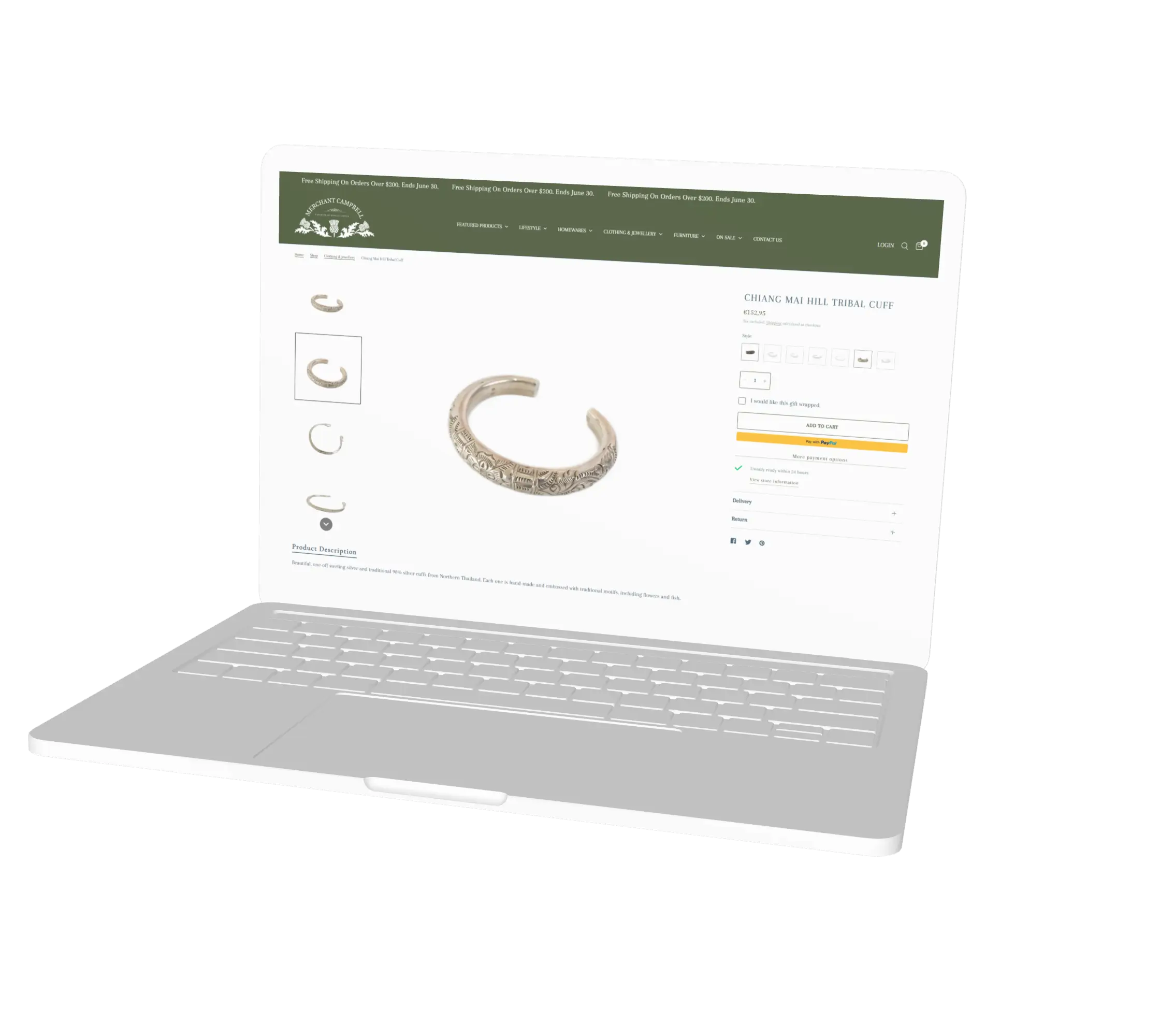
A Successful Retail Transformation
Merchant Campbell successfully modernised its retail technology stack, replacing a disconnected legacy point-of-sale with a fully integrated Shopify ecosystem.
The project delivered a true unified commerce experience: customers are now recognised whether they walk into a store or visit the website, inventory is consistent across channels, and the brand has a single source of truth for every transaction.
Acidgreen’s expertise in Shopify POS implementation and data migration ensured a smooth cutover with zero disruption to in-store operations and no loss of historical data — laying a solid foundation for the next phase of omnichannel growth.
Results

UNIFICATION
One Shopify ecosystem connecting in-store and online channels for a consistent, frictionless customer experience

MIGRATION
Full migration of customer data and order history with complete continuity, deduplication, and zero data loss

EXPERIENCE
Seamless retail and digital journey — consistent pricing, inventory, promotions, and customer recognition across every touchpoint

DATA
A centralised customer database that powers smarter marketing, loyalty, and personalisation strategies

Why Shopify POS for Unified Commerce?
Shopify POS is more than a cash register — it is the in-store extension of a full unified commerce platform. By connecting physical retail with the Shopify online store, retailers gain:
- A single source of truth for products, inventory, pricing, and customers.
- Real-time stock visibility across stores and warehouses, opening the door to click & collect, ship-from-store, and endless aisle.
- A unified customer profile that captures every interaction — in person, online, or via support — for richer segmentation and personalisation.
- A lower total cost of ownership thanks to native integration, fewer middleware layers, and simpler operations.
- A future-proof architecture that scales with new locations, new markets, and new commerce models.
Frequently Asked Questions
Shopify POS is Shopify’s native point-of-sale solution. It connects physical retail operations to the same backend as the Shopify online store, allowing inventory, customers, orders, and promotions to be managed in one place — the foundation of unified commerce.
Acidgreen uses a structured ETL approach: extraction from the legacy system, cleansing and deduplication, mapping to Shopify’s data model, controlled import, and reconciliation reporting. The goal is zero data loss and complete continuity of customer and order history.
Yes — that is one of its key advantages. Shopify POS shares the same backend as the Shopify online store, so customer profiles, inventory, pricing, and order history are unified across channels by design.
Depending on store footprint, data volumes, and integration complexity, projects typically run from a few weeks to a few months. Acidgreen scopes each engagement to balance speed of value with risk-managed delivery.
Acidgreen is an experienced Shopify and Shopify Plus partner with deep expertise in retail, unified commerce, data migration, and complex integrations — supported by a long track record of award-winning eCommerce projects in Australia.

Ready to Unify Your Retail and Online Experience?
If you are evaluating Shopify POS or planning a unified commerce transformation, Acidgreen can help you scope, design, and deliver the right solution for your retail business.
On the same topic
View all2026 is the year digital commerce stops being just a channel and becomes a capability. Not because AI can generate content, but because AI is becoming an active participant in how customers discover, compare, and move toward purchase. The brands that win won’t be the loudest, they’ll be the most legible to machines.
Read news
 Pimcore
Struggling to structure and manage your product data efficiently? Building a solid data flow in Pimcore is key to ensuring consistency, automation, and scalability. In this article, we walk you through the essential steps to design a streamlined product data workflow that powers performance across all channels.
Read news